Ever since the War of 1812, Congress tried to protect American industries by raising the tariff on foreign goods. However, the South despised the tariffs because it favored northern businesses and forced southerners to purchase expensive American goods.
Jackson's vice-president, John Calhoun, represented South Carolina, and he called the newly-increased Tariff of 1828 an abomination, giving voice to the belief in the South that they "paid for the wealth of New England." So Calhoun boldly developed a nullification theory. He argued that because the U.S. Constitution was based on a contract with the states, each state had the right to nullify (reject) a federal law that it believed to be unconstitutional.
The theory sparked an intense debate in the Senate, but everyone wanted to know what President Jackson had to say. On April 13, 1830, Jackson gave a telling toast at a dinner party: "Our Union--it must be preserved." Calhoun quietly resigned, and the issue was laid to rest... for a short while.
In 1832, Congress increased the tariff yet again, and this time, South Carolina didn't wait to debate. They claimed that the tariff acts of 1828 and 1832 were unconstitutional and declared it "null, void, and no law!" Then they threatened to secede (leave) the Union!
Jackson didn't hold back this time. He pushed Congress to pass the Force Bill, which allowed the federal government to use military force against a state that resisted paying proper duties. With violence about to erupt, Congressional leader Henry Clay stepped in and proposed a compromise that would gradually lower the tariff over the next decade.
For now, the storm subsided...
Why do you think Jackson responded the way he did the FIRST time the nullification issue arose? Why do you think he responded differently in 1832? Put yourself in Jackson's shoes: would you have done the same? Why or why not?
Wednesday, November 9, 2011
Removal of Native Americans
Since the 1600s, the conflict between Native American tribes and European settlers had long been a problem. Settlers either wanted to convert and absorb the native population into white society or displace (remove) them altogether.
Jackson was in favor of displacement when it came to the Native American issue. In 1830, he pushed for Congress to pass the Indian Removal Act. Under this law, the national government would pay and negotiate treaties that would dispossess the southern tribes and move them west. While Jackson called this policy "not only liberal, but generous," few native tribes thought so. For instance, the Choctaw of Mississippi were forced into treaty negotiations while the Sauk, Fox, and the Chickasaw were militarily removed from Illinois, Missouri, and Alabama.
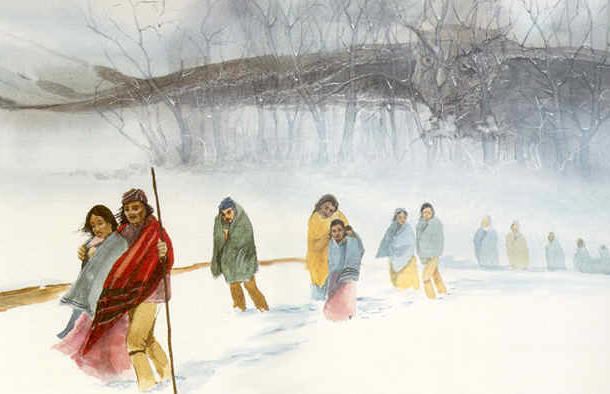
When the Cherokee nation decided to take the U.S. government to court, they were undermined by federal agents who worked out a deal with a minority Cherokee group. 8 million acres of Cherokee land was signed over for $5 million. The final blow arrived when Jackson's predecessor, President Van Buren, forcibly removed 20,000 Cherokee and sent them on a brutal 800-mile journey. The natives made most of the trip on foot in the middle of winter, and many died on the walk that is remembered in history as "The Trail of Tears."
Even the people during Jackson's presidency were torn about the Indian Removal Act. Some believed it to be "a terrible injustice" while others argued that it was "unfortunate but necessary." What do you think, and why?
Tuesday, November 8, 2011
Jackson's Spoils System
During the 1828 election campaign, Jackson categorized his opponent as an "intellectual elitist" who could not relate to the plight of the "common man." With that message, he won a landslide victory and became the 7th president of America.
However, when he entered the presidency, Jackson was faced with a problem. Many of the appointed government positions were filled with those loyal to the previous president: Adams. Thus, Jackson put into place a "spoils system," following the motto: To the victor belong the spoils of the enemy. New officials replaced the previous Adams-supporters. Nearly 10% of federal employees were fired and replaced by Jackson's friends. These later became known as Jackson's "kitchen cabinet" because they slid in through the back door.
As a new president, you have the power to appoint many people to government jobs. You also face the threat of previous employees undermining your administrative work as the president. Would you have done what Jackson did? Why or why not?
The 1824 Election
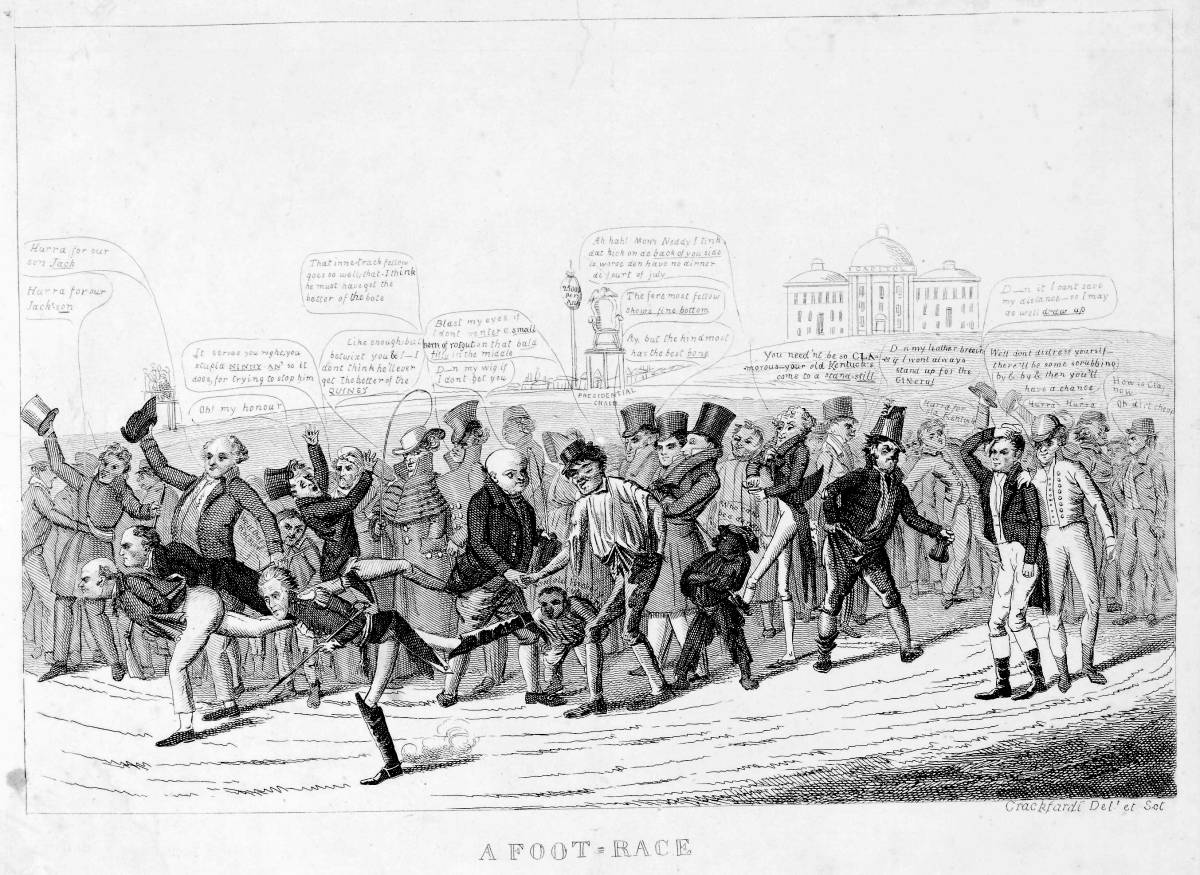
Henry Clay, himself an 1812 war veteran, personally hated Jackson. John Adams, on the other hand, agreed with Clay's political agendas (i.e. American System, nationalism, etc). So Clay swung the House's votes away from Jackson, and Adams became the 6th president of America.
Jackson and his followers became outraged and accused Adams of "striking a deal" with Clay. They formed the Democratic-Republic Party (the forerunner to today's Democratic Party) and sabotaged Adams' presidency at every turn. Jackson vigorously campaigned against Adams, and in 1828, won a landslide victory with three times the voting turnout (mostly by poor, working-class white males who supported Jackson) than the 1824 election.
In the end, Jackson had the last laugh.
Do you sympathize with Jackson? If you were in his shoes in 1824, how would you have responded?
Thursday, September 22, 2011
I really love U.S. History.
As a a lot of people have already said, I'll continue to be bland and un-original by saying that the short clips and such a quite helpful. Visual learning is key to my way of learning and I suppose it is the same with others. I enjoyed watching the reenactments of the battles instead of just reading them and trying to visualize my own version in my head.
-Brandon AkA Yumyumcult
Monday, September 19, 2011
September 15th, 2011
We went over the Lexington battle, and we were shown a video of Sarah Palin getting history facts wrong. It was pretty funny, and Mrs. Ilie told us that we needed to learn history so that that wouldn't happen to us if we were in that situation. We talked about what led up to the colonies fighting against the British, and we watched a video on it. The video we watched was really interesting, because it gave us a visual of how the battle went down. It was also intriguing and thought-provoking. Something that could be improved is more partner activities or class activities, and maybe some class discussions. I think it would be helpful to the understanding of the theories behind the wars.
Saturday, September 17, 2011
Tuesday, September 13
On Tuesday, September. 13, we started the class up by getting back our graded homework. Now since some of the homework not exactly what was expected, we spent a long time going over the homework, and making sure that everyone understands what happened (in the book). Also after we were done we watched a clip from the movie "Last of the Mohicans" and answered some questions about it. I really enjoyed watching the movie in class, and the only thing i have to suggest is that we do more things like it (watching videos). I think visual learning is just a great way to understand the subject.
Subscribe to:
Posts (Atom)