- Religious revival - Brad
- Utopian comunities - Nick; Federico
- Social reforms - Megan
- Educational reform - Clara; Costa
- Abolition in the North - Jonathan; Nate
- Pro-slavery movement in the South - Katie; Dakota
- Women abolitionists - Emily; Barak
- Temperance movement - Richie
- Women's education - Erica; Joey
- Women's rights/suffrage movement - Tori; Adele
- Immigrant workers - Allen; Tommy
- Trades' unions - Daniel
- Industrial & Market Revolution - Lisa; Shannon
- Native American conflicts - Brandon
- Westward trails - Jessica
Wednesday, November 16, 2011
Antebellum America Project Topic Assignments
Here are your topic assignments. Most people got either their 1st or 2nd choice:

Wednesday, November 9, 2011
Jackson and Second National Bank

Unfortunately for the National Bank supporters, they miscalculated the public's loyalty to Jackson and dislike of the bank itself. In 1832, Jackson--as predicted--vetoed a bill from Congress to renew the charter of the Second National Bank. However, he waged a very personal and public war against the BUS. He convinced the public to think of the BUS as a "privileged institution" that supported the "rich fat cats" in business. He argued that federal taxes were deposited into the BUS, but the private stockholders of the bank earned all the interest, not the average American taxpayers.
Jackson won the reelection of 1832. From the presidential mansion, Jackson undermined the BUS and had the secretary of the treasury move all of the federal funds to state banks that became known as Jackson's "pet banks." When desperate businessmen requested loans from Jackson's banks, he refused them. Pressure mounted, but in the Jackson won: the BUS' charter expired and 5 years later, it went out of business.
During the banking debate, many accused Jackson of being vindictive, stubborn, and actually causing an economic crisis. Some members of his own party believed Jackson was misusing the power of the presidency. Why do you think Jackson waged such a war against the BUS? Do you believe his motives and actions to be "appropriate" for the presidency?
The Nullification Crisis

Jackson's vice-president, John Calhoun, represented South Carolina, and he called the newly-increased Tariff of 1828 an abomination, giving voice to the belief in the South that they "paid for the wealth of New England." So Calhoun boldly developed a nullification theory. He argued that because the U.S. Constitution was based on a contract with the states, each state had the right to nullify (reject) a federal law that it believed to be unconstitutional.
The theory sparked an intense debate in the Senate, but everyone wanted to know what President Jackson had to say. On April 13, 1830, Jackson gave a telling toast at a dinner party: "Our Union--it must be preserved." Calhoun quietly resigned, and the issue was laid to rest... for a short while.
In 1832, Congress increased the tariff yet again, and this time, South Carolina didn't wait to debate. They claimed that the tariff acts of 1828 and 1832 were unconstitutional and declared it "null, void, and no law!" Then they threatened to secede (leave) the Union!
Jackson didn't hold back this time. He pushed Congress to pass the Force Bill, which allowed the federal government to use military force against a state that resisted paying proper duties. With violence about to erupt, Congressional leader Henry Clay stepped in and proposed a compromise that would gradually lower the tariff over the next decade.
For now, the storm subsided...
Why do you think Jackson responded the way he did the FIRST time the nullification issue arose? Why do you think he responded differently in 1832? Put yourself in Jackson's shoes: would you have done the same? Why or why not?
Removal of Native Americans
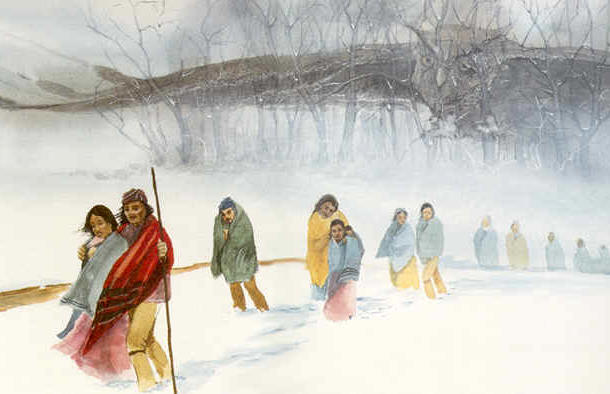
Jackson was in favor of displacement when it came to the Native American issue. In 1830, he pushed for Congress to pass the Indian Removal Act. Under this law, the national government would pay and negotiate treaties that would dispossess the southern tribes and move them west. While Jackson called this policy "not only liberal, but generous," few native tribes thought so. For instance, the Choctaw of Mississippi were forced into treaty negotiations while the Sauk, Fox, and the Chickasaw were militarily removed from Illinois, Missouri, and Alabama.
When the Cherokee nation decided to take the U.S. government to court, they were undermined by federal agents who worked out a deal with a minority Cherokee group. 8 million acres of Cherokee land was signed over for $5 million. The final blow arrived when Jackson's predecessor, President Van Buren, forcibly removed 20,000 Cherokee and sent them on a brutal 800-mile journey. The natives made most of the trip on foot in the middle of winter, and many died on the walk that is remembered in history as "The Trail of Tears."
Even the people during Jackson's presidency were torn about the Indian Removal Act. Some believed it to be "a terrible injustice" while others argued that it was "unfortunate but necessary." What do you think, and why?
Tuesday, November 8, 2011
Jackson's Spoils System
 Andrew Jackson has often been called the "'common man's" President because he seemed to understand the problems and concerns of everyday citizens. Jackson and his followers believed that an ordinary person could serve well as a leader. The "common sense" of the "'common man"' was all that was needed to be a good leader.
During the 1828 election campaign, Jackson categorized his opponent as an "intellectual elitist" who could not relate to the plight of the "common man." With that message, he won a landslide victory and became the 7th president of America.
However, when he entered the presidency, Jackson was faced with a problem. Many of the appointed government positions were filled with those loyal to the previous president: Adams. Thus, Jackson put into place a "spoils system," following the motto: To the victor belong the spoils of the enemy. New officials replaced the previous Adams-supporters. Nearly 10% of federal employees were fired and replaced by Jackson's friends. These later became known as Jackson's "kitchen cabinet" because they slid in through the back door.
As a new president, you have the power to appoint many people to government jobs. You also face the threat of previous employees undermining your administrative work as the president. Would you have done what Jackson did? Why or why not?
The 1824 Election
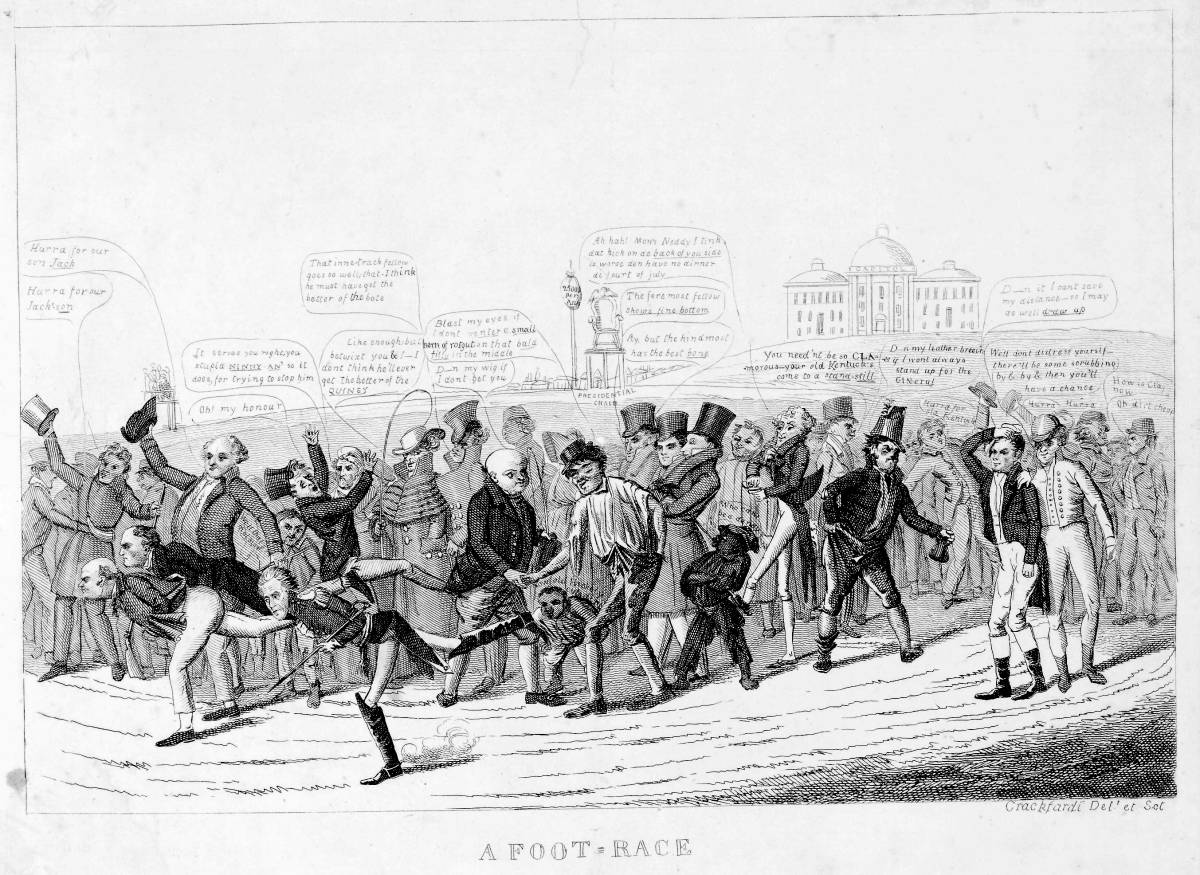 In 1824, 1812 war hero Andrew Jackson won the popular vote but did not gain the majority electoral college vote. In fact, none of the presidential candidates had the majority in the E.C.! So the House decided the outcome instead.
Henry Clay, himself an 1812 war veteran, personally hated Jackson. John Adams, on the other hand, agreed with Clay's political agendas (i.e. American System, nationalism, etc). So Clay swung the House's votes away from Jackson, and Adams became the 6th president of America.
Jackson and his followers became outraged and accused Adams of "striking a deal" with Clay. They formed the Democratic-Republic Party (the forerunner to today's Democratic Party) and sabotaged Adams' presidency at every turn. Jackson vigorously campaigned against Adams, and in 1828, won a landslide victory with three times the voting turnout (mostly by poor, working-class white males who supported Jackson) than the 1824 election.
In the end, Jackson had the last laugh.
Do you sympathize with Jackson? If you were in his shoes in 1824, how would you have responded?
Subscribe to:
Posts (Atom)