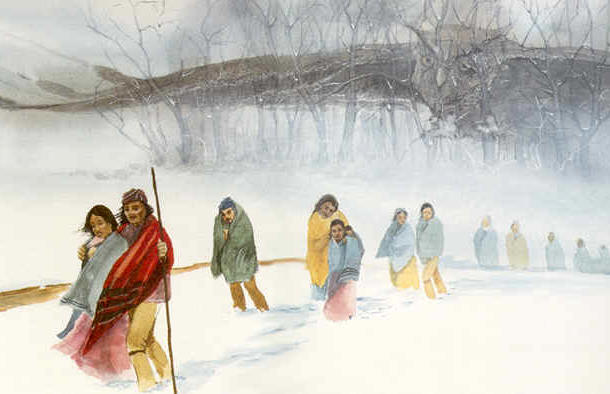
Jackson was in favor of displacement when it came to the Native American issue. In 1830, he pushed for Congress to pass the Indian Removal Act. Under this law, the national government would pay and negotiate treaties that would dispossess the southern tribes and move them west. While Jackson called this policy "not only liberal, but generous," few native tribes thought so. For instance, the Choctaw of Mississippi were forced into treaty negotiations while the Sauk, Fox, and the Chickasaw were militarily removed from Illinois, Missouri, and Alabama.
When the Cherokee nation decided to take the U.S. government to court, they were undermined by federal agents who worked out a deal with a minority Cherokee group. 8 million acres of Cherokee land was signed over for $5 million. The final blow arrived when Jackson's predecessor, President Van Buren, forcibly removed 20,000 Cherokee and sent them on a brutal 800-mile journey. The natives made most of the trip on foot in the middle of winter, and many died on the walk that is remembered in history as "The Trail of Tears."
Even the people during Jackson's presidency were torn about the Indian Removal Act. Some believed it to be "a terrible injustice" while others argued that it was "unfortunate but necessary." What do you think, and why?

I think that it was a very inhuman and unjust thing to do, but I do believe that it was very necessary. The conflicts between the natives and the settlers would soon rise beyond belief to cause a war on their own territory. While the founding fathers wanted to expand territory and population, the Natives were taking up useful space. They had very different views and they both werent working to the same goal.
ReplyDeleteI believe that this was a terrible decision that Monroe made. Though it allowed the U.S. to gain more land, it is unfair to make the Native American's to move out of their territory. You have to think about it as if you are them. It would be unfair to be forced out of your own land and instructed to walk over 800 miles. Along the way many people died which is why this is a terrible act.
ReplyDeleteThis comment has been removed by the author.
ReplyDeleteI personally think that it was "a terrible injustice". Although this conflict had gone on for a long time, I think that settlers could have dealt with the issue in a more mature and diplomatic way. They could have tried to get along with the Native Americans and create compromises rather than taking the land for themselves and displacing them. People that think that it was "unfortunate but necessary" probably thought so because they didn't realize that there were other solutions.
ReplyDeleteThere are going to be conflicts of every kind in every society, big or small. There is no way that the U.S. can justify displacing 20,000 people, even if they gave them money.
I agree with Nick. Although it was a terrible thing to do it had to bappen. Most of the Natives agreed to the removal for 90 treaties were signed
ReplyDeleteI think this was a bad idea that was made by Monroe because, from my perspective, Monroe thought only about his problems, not about the problems the Native Americans would have after being Removed. I think Monroe should have thought about the natives before doing so.
ReplyDeleteI also agree that this was a bad decision on Jackson's part. He removed the Native Americans west so the Americans could live on their land. I believe that he could have left the Native Americans on the land, where they have resided for such a long time, and let the new settlers go farther west, where there is new land, and the Native Americans don't have to go out of their way to move for the new settlers.
ReplyDeleteThe Natives were here first and we just came in and took all of there land, and made them move. I think that the removal was wrong in a sense that we used our stronger resources and pure people mass to beat them, and take the land. We should have shared the land and not been so greedy....
ReplyDeleteI agree with Nick as well. It was wrong but it was necessary also. Based on other problems in history, when there is a conflict between two places it usually leads to a war and if the act was not set up then there is a huge chance that a war could have broken out.
ReplyDeleteI agree with allen, for once, I think Monroe was only thinking of himself and just about his problems and not about the natives.
ReplyDeleteI think that Monroe was not thinking of himself. I think he was thinking of the majority of the nation and was trying to do the right thing
ReplyDeleteI think that this sort of thing had to happen at some point, even though it may not have been the nicest thing to do. The Native Americans were only holding things up and Jackson decided to take charge and move them so the majority of the people would be satisfied.
ReplyDeleteI disagree, I actually don't believe that this was in any way necessary. We can never know if there actually would have been a war, but we defiantly could have tried to share the land. The Native Americans were clearly there first, and we had no right to go in and take the land away from them. Especially when there was more land for us to go to. If all the land in the country was taken, it would be a completely different story, but we could have sent the settlers West in the first place..
ReplyDeleteI would completely oppose of Monroe's decision because it went against the Indians liberty. The Indians were the native people of the territory and were forced to move out of their land. Although the Natives gained $5 million when their Cherokee land was taken, it was unjust to remove the Indians and resulted in The Trail of Tears where many died throughout the passage. Therefore it was cruel of Monroe to take their land from them.
ReplyDelete@Erica, yes he was trying to do what was right for the American people but he should have also thought what was right as a human, it isn't like that the Natives didn't deserve there land because they weren't American.
ReplyDeleteI disagree I think in the end it was the right thing to do. Natives still had land and they also got $5million for the exchange
ReplyDeleteErica, you and I are on the same page right now. I think Monroe wasn't trying to be unfair in any way, it just so happens that his decisions made some people unhappy but helped out more people in the end.
ReplyDeleteI think it was a terrible thing to do, if we felt we really "needed" the land we could have at least tried to have given them a better trade than the little amount of money we gave them for moving to even worse land. We should have given them a fair about of money for the land and have tried to give them better or equally good land in return.
ReplyDeleteSomething to think about for all of you... do you think the 90 treaties that were signed were legitimately welcomed and true negotiations? How about considering the power difference between the US government and the native tribes? A nation weaker than another would need to cave in whether they agreed with a policy or not...
ReplyDeleteI thought it was almost necessary because there was nothing else really to do with them. They should have been given an option to join the population or move.
ReplyDeleteWe also gave them land west of the Mississippi. If the Natives were against this trade so many shouldn't have agreed
ReplyDeleteI think it is extremely unfair and unnecessary for Jackson to relocate the Native Americans. Native Americans arrived in North America way before the white people did. Moving them to another location will not solve the problem. Native Americans are still going to be in the United States. So relocating them was not a great solution. But instead, keeping the Native Americans in the same place and relocating the Americans should be a better solution.
ReplyDeleteI think they were trying to do what was best for the country at that time. The government and colonists want the country so they can expand and create a society. It is hard to do that if you have another type of people in your way. Do I think they should of completely kicked them out and made them move west. No. But I do believe that they should of dealt with them and allowed them to stay. Even though if they allowed them to stay there would of been a lot of arguing and fighting so I suppose it was a good idea to have them move, even though it isn't always the right thing.
ReplyDelete@Megan; you have to understand that the American people didn't think that was land for them to "take." They felt more like it was land that already "belonged" to them and getting the Native Americans off their land was something they were supposed to do in order to get the land they thought they deserved. In that sense, I feel like the American people would never have been satisfied if we didn't claim the land further to the west, and in that sense, I think it's almost admirable (almost, mind) that we didn't elevate the issue to a full-scale war. There was no pleasant way for the land situation to end, so I think that Monroe ending it the way he did was for the best, so that the issue didn't become even larger in scale than it already was.
ReplyDeleteOkay, if I was in the shoes of the Native Americans, I would not appreciate being told to just GET OUT of my own home! I agree with Lisa, it's not like Monroe absolutely had to kick them out. They could have signed some peace treaties or made compromises about the land. Lisa used the right word when she said the decision was immature, why can't they just get along instead of refusing to accept that living near eachother is possible?
ReplyDeleteErica, I disagree. The loss of Cherokee lives cannot be given an amount of land or a monetary price. Jackson may have been thinking about expansion, but the US already had Georgia as a state, and as Jessica said, the settlers could have moved to other places because there were other areas of land. We need to keep in mind that it's not just land, it's also tearing Native Americans away from their roots, their culture, and their sacred places. That kind of thing can't be made up for.
ReplyDeleteWell said Lisa. :) They have been attached there, not only because that is physically settled, but they are also mentally settled there. Although those thought usually aren't brought into politics, it's very easy for me to sympathize with the Native Americans.
ReplyDeleteI think that it was a pretty terrible thing to do, i understand that many treaties were signed but not all of the natives agreed to this; the tribes that were kicked out were forced to go through the brutal march; which in my opinion is inhumane. But i was also wondering if anyone knew if the natives fought back against the troops that tried to kick them out, was there any battle that resulted from this?
ReplyDeleteI agree with Lisa, when the Natives were removed, they were also removed from their roots, culture, and to add to that, they lost a lot of food/shelter.
ReplyDeleteThe only solution that would have worked would be to move the native americans farther west. Jackson did think of other possibilities before. The removal process was "not only liberal, nut generous"
ReplyDeleteI believe that this was unfortunate but necessary. To continue moving forward with the expansion of the nation, we needed to expand westward. This required us to move the Native Americans out of the area that we needed. Though this was very unfortunate for the Native Americans, we made a deal with them and they accepted. This means that they didn't think that them giving us land would be such a big deal. I think this is just a case of, that's how the cookie crumbles.
ReplyDeleteI agree with Adele and Lisa: these populations were mostly small populations that had a really small territory compared to the US, they would never interfere with the economy plans of the US goverment. Since the first colonists came to America the native populations were always forced to move away from their and exploited. That's not nice and the American population should have stood up for them and sabotage this act, at least for once.
ReplyDelete@COSTA I WOULD HAVE TO DISAGREE WITH YOUR OPINION. THE ACT MADE BY JACKSON, WASN'T EXACTLY CORRECT BECAUSE THE NATIVE AMERICANS WERE THERE FIRST. YOU MENTION SOMETHING ABOUT MAKING PEOPLE HAPPY, BUT THIS WASN'T ANYTHING TO MAKE THE NATIVE AMERICANS HAPPY. THEY HAD TO WALK 800 MILES AND SEE THEIR TRIBAL MEMBERS DIE ALONG THE WAY. IT MAY HAVE HAD TO BE DONE BUT IT DIDN'T NEED TO BE DONE IN THIS SEVERE OF A WAY. THEY SHOULDN'T HAVE TO BE MOVED FROM THEIR TERRITORY WHEN THEY WERE THERE FIRST.
ReplyDelete@Costa I strongly disagree with your view on this cruel act by Jackson because this removal lead to many deaths through the Trail of Tears. If Jackson did not remove the Native Americans, there wouldn't be unnecessarily deaths of his own US citizens. There could have been an alternative method of peacefully moving the Native Americans out of the fertile land, which would have been a more respectful manner.
ReplyDeleteI think that the Indian Removal Act should not have happened. In the book, it talked about how some whites wanted to convert some of the Native Americans to Christianity, and have them assimilate to the white culture. All other Natives would be left alone to do what they want. Of course there would still be some conflicts, because there's no way to stop all conflicts between cultures. But I think that he should have let the Native Americans be and stay where they were. Over time whites would move into areas with Natives and Natives would move into areas with whites, and they would learn to live among each other.
ReplyDeleteHi jonathan, you are right there --->
ReplyDeleteLisa, I do agree that the loss of Cherokee lives cannot be given an amount of land or a monetary price. But, I think that at the time, they thought that the deal we made with the Native Americans was fair, or else we wouldn't have been able to make a deal with them.
ReplyDelete@TORI-- I agree completely that it is unfair to take the land away from the natives and move away from their homes. They were here first, and although they were thought of as the minority, whites should respect that it is their land and they were there first.
ReplyDeleteI agree with Lisa. You can't just remove Native Americans from their own home. They are the first ones in America. Just because they are not as strong as Americans, it doesn't mean they can remove them to a different place. Why can't there be a "first come first serve" rule on land? There are plenty of other places for Americans to settle in. Why can't the Americans settle there? Why did they have to move the Native Americans from their home?
ReplyDeleteThe central argument that would support it being necessary is that there was no other solution. However, there are a plethora of solutions, such as diplomatic discussions (instead of just kicking them out), moving some of the American population of George out west, not trying to assimilate Native Americans, and many others. So yes, there were other peoples. Another argument could be that they "struck a deal". However, Jackson struck a deal with the VERY LOW MINORITY, which is a bad representation of the Cherokee Nation. It was not fair whatsoever. If the removal process was "not only liberal, but generous", then please explain how it is liberal and generous.
ReplyDeleteThis is the definition of liberal:
Open to new behavior or opinions and willing to discard traditional values.
If Jackson was thinking about it LIBERALLY, then he would have had diplomatic discussions with the MAJORITY of Native Americans, not the minority, and a solution would have been to work together WITH the Native Americans. And like I said before, many people losing not only their lives but also their traditions and cultures in exchange for money is not generous at all.
@Victoria I think this is all a misunderstanding. I was not happy with all the people dieing, I think there could have been a better way of going about this, but I do think that they had to leave at some point.
ReplyDelete@Shannon, I see where you're coming from, but I don't that would happen. I don't think it is possible for people whose views of land are so different to live side by side on the same land. At some point, one would want the other out. I don't think the Indians would be able to stay and have peace with whites.
ReplyDeleteeven though they were given land in return as compensation for their journey, it still cannot repay the lives lost along the way. I mean, come on, it was called the TRAIL OF TEARS.
ReplyDeletemost likely caused by SADNESS.
ReplyDeleteI agree with Shannon with Americans wanting to convert Native Americans to Christianity. Why can't Americans convert to Native Americans and except their culture?
ReplyDeleteI believe that Monroe's choice to displace 20,000 people in order to appeal to the incoming white settlers was immoral and wrong. Rather than leading so many Native Americans on a journey that brought them great misery and death, a less-drastic compromise could have been created that would have settled the overall disagreement. Although the end result still might have been unfair to the Native Americans, it was unnecessary to enforce the Indian Removal Act because it crossed the line of unfairness that the Native Americans were to suffer.
ReplyDelete